 |
| Startup: The Ultimate Startup Small Business Checklist [Infographic] |
The thought pursuing a dream business can be very exciting, but actual work that goes into it may not be. In order not to put the cart before the horse in the startup of a small business a few things need to be put in place and a certain process needs to be followed.
Starting a small business can in many ways be both daunting and scary. If you have a vision and the skills to realize it, the business in itself just requires some book smarts. You won’t even believe how much information it is out there to put you on the right path. That information can guide you through the maze of setting up a startup company. Help comes in all kinds of shapes and forms, and this time it’s in a small business checklist.
The first thing to keep in mind is that the number of people who will tell you it can’t be done or that you’re doing it wrong will be surprisingly high once you take the step to get started. The world is full of people who will try and defuse your excitement and commitment to your product or service, so the best thing you can do is keep going. The success of your endeavor should be enough to silence any doubts.
Nevertheless, there are obstacles you need to pay more attention to than the noise generated by public opinion about the legitimacy of your startup. Correctly registering and filing all documents is vital in order for you to feel completely secure once you start pulling the strings that will take you to success. In order to bring some light to the process, if you’re thinking about starting a small business in the U.S., I have been presented an infographic called The Small Business Checklist: How To Establish Your Business – Legally by
ContactMe.
ALSO SEE:
Starting Up: Quick Guide To Starting A Small Business [Infographic]This infographical guide will take you through the process one step at a time. When you reach the end of it, you will have a somewhat solid foundation to build your success on. There are many more facets to building a successful business of course, but this small business checklist will solidify your startup in a secure and comfortable way. All you need to do after everything has been filed, registered, approved and confirmed is to take your idea and stay motivated, dedicated and true to your vision. Success is obtained by the presence of a vision. Without it, there will be little you can do to bring success into your endeavor.
Infographical Small Business Checklist
(Click Infographic To Enlarge)
Post Credits
Post Author: Richard Darell
 |
| Startup: 8 Intellectual Property Items Every Startup Needs (StartupProfessionals) |
Startup: 8 Intellectual Property Items Every Startup Needs (StartupProfessionals)Most times the excitement of seeing our ideas materialize into a startup, we tend to neglect some key intellectual property measures to take. Marty in this post listed 8 intellectual property items every startup requires to successfully run a startup.Also Read: Yahoo Is The World’s Largest StartupA large portion of your competitive advantage and your potential value to investors is the size of your intellectual property portfolio. When someone says Intellectual Property (IP), most entrepreneurs think only of patents. In reality, patents are only one of at least eight items that should be in your IP portfolio. You need all these before you start looking for funding.
Some of the other items may cost a lot less, and may be worth far more in the long run. Here are the key elements:
Company Name.
The company name becomes your intellectual property at the moment you incorporate your startup as an LLC or a Corporation. Sole proprietorships need to trademark the name to protect it. Select it well – marketers will tell you that you will be selling your name, more than your products. Actual incorporation fees in many states are below $100, if you do it yourself. Don’t pick a company name until you are certain that you can get the comparable domain name, so Internet brokers won’t hold you hostage.
Internet Domain Name.
This name (www.domainname.com) is just as critical as the company name, and the two should match as nearly as possible. Significant differences will confuse your customers, and open the door to imitators and scam artists. Internet domain names can be acquired from most hosting providers or
Network Solutions, for as little as $10/year each.
Social Media Accounts.
Immediately go to relevant
social media sites and grab the same name, even if you never plan to use the accounts. Many companies like Sears, Coca-Cola, and Twitter have already been hurt by people using company names they don’t own on social sites. These days, every business needs a blog, so sign up your domain names accounts on TypePad, Wordpress, and Blogger, or all of the above, before someone starts blogging in your name.
Patents.
Remember that ideas cannot be patented, only novel implementations. But the application or provisional application has to be registered before you disclose the details to investors or consumers, or the implementation will be deemed un-patentable. Patent attorney fees start at around $5K.
Trademarks.
A trademark is a name, phrase or logo that tells the consumer the origin of the goods and distinguishes your goods from those of your competitor. Trademarks require a federal trademark registration from the
United States Patent and Trademark Office. The cost for a single trademark is around $300.
Copyrights.
No registration and no cost is required to secure a copyright on written, audio, or video material that you create to be attributed to your company. Still, it is recommended that you add the familiar ©Copyright 2010 symbol at the beginning or end of each media and document segment.
Trade Secrets With Employment Agreement.
Companies often use non-patentable but important trade secrets to run their business. These trade secrets need to be documented and coupled with an employment agreement, to keep them from migrating to your competitors when employees move on.
Business Plan.
Your business plan holds the keys to your kingdom, so you don’t want it in the hands of competitors. If you need early reviews or assistance by people you don’t know well, get them to sign a Non-Disclosure Agreement first. A
sample agreement is available for free download from my website.
In cost, all of these elements of intellectual property may be acquired for a few hundred dollars (or a few thousand with an attorney), if you act early and quickly. Later, good intellectual property can be worth millions when your company valuation is set for investment purposes, or when the company is acquired or sold. In between, you need it to survive.
Post Credits
Post Author: Marty Zwilling
 |
| Startup: Yahoo Is The World’s Largest Startup – Marissa Mayer (Yourstory) |
Startup: Yahoo Is The World’s Largest Startup – Marissa Mayer (Yourstory)Marissa Mayer a former Google executive and a seasoned technology expert now the CEO of Yahoo shared some very useful strategic tips every startup and CEO should give ultimate attention to in order to succeed.Also Read: Startup: Google Android Executive, Hugo Barra Joins Chinese Startup XiaomiIn a technology world that has relatively very few women at the top, a fabulous ‘HerStory’ has been that of Marissa Mayer. Coming from Google, Marissa has been the CEO of Yahoo for a little more than a year, and the impact is evident. The company is performing much better, with stock prices doubling, and valuation going up north. During her talk at TC Disrupt, San Francisco, she shared some points worth every CEO’s reflection.
Largest StartupWe pride ourselves at Yahoo as being the world’s largest startup. We are entrepreneurial despite being an established company.
Four ThingsPeople, Product,
Traffic, and Revenue. We have had a chain reaction, with first having the right people, having the people build the right product,
which in turn leads to traffic, and the
traffic ultimately leads to revenue online. So, it’s kind of a chain reaction working like a funnel: getting the right people to build the right product; the product has to be good for users to come in; and, once you have the usage, you can continuously grow it, and get the advertisers.
NumbersWe get 12,000 resumes a week, up by a factor of five. There are 12,000 employees in the company, and attrition has come down. Traffic is 800 million monthly active users, core to our growth. That is 20 percent increase in the active users. We want more time and attention from our users and are working in that direction. The focus is on personalisation and mobile.
MobileThe big piece I’m focused on is mobile. We’ve grown our mobile team by a factor of 10. We’ve had the web, and are now getting focused on mobile. Mobile users are 315 million, with daily search of homepage, mail, sports, and finance.
SimpleI like basic, simple, and efficient stuff. And Yahoo mail is just that. It loads faster, does not have distractions, and fulfils the objective of mailing.
IndustryA strong Microsoft is good for the industry. Bill Gates and Steve Ballmer have been huge fixtures in the industry.
CEOI love hard work, and I love challenges. Challenges have been more exhilarating than exhausting for me. Nothing can beat the passion and hunger of a founder.
One of the CEOs said to me, “The thing that’s shocking about the role of a CEO is how so few decisions you have to make, but you have to make them perfectly.” So, as a CEO you have to make fewer decisions, but absolutely and totally correct ones.
Job of a CEO is to grow the revenue.
Post Credits
Post Author: Marissa Mayer
Startup: The Internet Of Things Startup From Oulu - Sensinode Got Acquired By ARM (Arctic Startup)
By now, a lot of people agree that the next big thing in the world of technology will be
in the realm of the internet of things. When every single device you own will be able to talk to one another and make
smart decisions based on those interactions. That includes lights, TV’s, fridges, cars, doors, microwaves, basically - everything little thing that can, will be connected.
Sensinode was one of the companies that was aiming to make this a reality by developing a standards based technology because otherwise you would end-up with a lot of proprietary protocols which prevents scaling that the internet of things really needs.
Through this process, they have developed NanoStack and NanoService products that helped to connect all sorts of nodes in an internet of things network. It took over seven years to bring the technology to maturity and at this point the company became an attractive purchase.
Which has basically led to the purchase
by the British ARM, a multinational semi-conductor company, whose processors and chips can be found in Apple, Samsung, Nokia (Microsoft) devices.
However the company has always been known for trying to be present in as many devices as possible and this goes in-line with the purchase as they are really getting ready for the internet of things. After all, this market is predicted to grow by nearly 30 billion devices, according to research
conducted by IHS.ARM is planning to offer Sensinode products to their existing and new clients, which gives a very large base for the startup. According to Adam Gould, the CEO of Sensinode,“The ARM architecture together with Sensinode’s software technology covering 6LoWPAN, CoAP, and OMA Lightweight M2M with advanced security will provide a compelling solution for Internet of Things developers.”
The company has been around for a while and received funding from Tekes as well as Series A in 2010 and Series B in 2011. One of the latest investments was done by
Conor VC, so this was definitely a rather fast exit for them.
We have reached out to both Conor VC and Sensinode for further comments and perhaps a hint at the deal size and will update the story should we find out more.
Post Credits
Post Arthur: Dmitri Sarle
 |
| Startup: Chicago Startup Doggyloot Raises $2.5M In Funding (Chicago Tribune) |
Startup: Chicago Startup Doggyloot Raises $2.5M In Funding (Chicago Tribune)
Doggyloot, a Chicago-based pet products e-commerce company, said Monday it has
raised $2.5 million in funding.Northbrook-based Origin Ventures, which has invested in local tech companies such as GrubHub, led the round. Chicago-based Sandbox Industries, which operates a venture fund called the Sandbox Advantage Fund, also participated.

Doggyloot was developed as an internal project at Sandbox, which
incubates its own startups in addition to investing in companies. Marbles: The Brain Store, the retail chain, came out of Sandbox. Doggyloot, which offers deals on pet products for members and sells other items on a subscription basis, grew out of Dashmob, a now-defunct Sandbox company focused on highlighting real-time, location-based deals at nearby merchants.
Post Credits
Post Arthur: WailinWong
 |
| Start: Minas Gerais Kicks Off Multimillion-Dollar Tech Startup Program (Zdnet) |
Start: Minas Gerais Kicks Off Multimillion-Dollar Tech Startup Program (Zdnet)Summary: Initiative will see the acceleration of 120 early-stage ventures by the end of 2014
The government of Minas Gerais will inject R$15mi ($6.2mi) in a startup acceleration program designed to retain talent and bring investments to the Brazilian state.
The Startups and Entrepreneurial Ecosystem Development (SEED) program will provide up to R$80,000 ($34,000) in
equity-free funding to 40 startups led by one person to three people each. Three rounds of the program are expected to take place until the end of 2014.
The acceleration and mentoring program will last six months and during that time, the entrepreneurs will be based in Minas Gerais capital Belo Horizonte and be part of a tech cluster dubbed "
San Pedro Valley." To start with, the initiative is not targeting any specific segments.
"We are open to any technology-based idea that is scalable and sustainable," says the chief executive at the Minas Gerais State Office for Strategic Priorities, André Barrence.
Local and international startups are encouraged to apply for the program and
the application process will commence in late September. The best ideas will be selected in October and the first intake of entrepreneurs will start on the program in December.
A private sector consortium has been chosen through a tendering process to deliver the startup acceleration initiative. This group of companies includes coworking firm The Hub, which is where the entrepreneurs will be based during the six months of the program.
As well as the government investment, other partners will support SEED in ways other than hard cash, including Google and Amazon, with resources such as cloud storage. The Minas government is also looking to attract investors to benefit from the startup ecosystem that it is working to create.
"While we will
accelerate startups, we want investors who believe in those ideas too. We already have a group, albeit limited, of investors, angels and so on, but we want to turn Minas Gerais into a destination for any investor looking for digital enterprises," Barrence says.
"And after a program like ours, those companies will had a 'seal of approval' of sorts - of couse not all of them will be funded, but backers will be much more comfortable when choosing their investments among the ideas we will accelerate and mentor," he points out.
A Paradigm ShiftA six-month period saw Barrence's team maturing the idea for SEED and establishing the framework for the program. He says that there were limitations that had to be overcome, such as the inability for the government to support individuals financially for the development of a tech-based business idea. A bill was put forward to make those changes possible, which then became law.
"[The ability to fund individuals] is something that only the state of Minas Gerais has; we will not require that the
entrepreneur has a formalized company to be part of the program. All we want is the ideas and the knowledge they will bring," Barrence says.
As well as fostering the creation of a center of innovation excellence in Minas Gerais, SEED is also intended to tackle a brain drain that has been affecting the state for decades.
"A major problem that bothers us a lot is the fact that we have talented people with very good educational backgrounds in Minas Gerais but end up leaving the state and going elsewhere. And we want to retain this human capital," Barrence says.
"We want to do that by bringing in companies that will create attractive jobs for these young people. At the same time, we will create an environment where they will create their own jobs by developing business ideas. The ideal scenario is to get people to think 'Why would I leave Belo Horizonte if there are plenty of interesting jobs here?'," he adds.
As the government will take no shares in the future companies, Barrence says the program's measure of success will be the creation of a whole new mindset when it comes to entrepreneurship and a
thriving startup scene in Minas Gerais.
"We want Minas to become the birthplace of digital technology entrepreneurs in Latin America and develop a tradition of nurturing people who turn great ideas into reality."
Post Credits
Post Arthur: Angelica Mari
 |
| Startup: Why I Quit My Job To Go Full Time On My Startup Weekend Venture (ToddGoldberg) |
Startup: Why I Quit My Job To Go Full Time On My Startup Weekend Venture (ToddGoldberg)This is an inspiring story on chasing the dreams of making one's idea a startup success.
If you were offered an opportunity to do something you love every day even though the odds for success were heavily skewed against you, would you go for it?
I recently had to make this decision and it was one of the toughest i’ve ever made. I had two options: continue a career path that provided amazing long-term opportunities and stability or pursue a unique opportunity as a co-founder at a technology startup that provides no stability, more than doubles the number of working hours, and pays nothing.
Spoiler alert: I went for it.
It all started about eight months ago when I went to Startup Weekend Tampa. Being relatively new to the Tampa Bay area, my expectations were to dip my toe into the startup community and make a few connections. What happened next was completely unexpected…
During the 54 hour event I pitched an idea called
EXMO, built a team, iterated on the idea, gathered feedback and spoke to potential customers. When it was all said and done, we gave the final pitch on Sunday evening where we won first place. To make things even crazier, since we won a Startup Weekend event during Global Entrepreneurship Week, we were entered into the Global Startup Battle. We only had 24 hours to create a 90 second video for the contest. We somehow ended up scripting, shooting, and editing the video in 7 hours. While we ultimately lost, it was a great experience. At the time of the weekend, the idea for EXMO was to be better connect people at events (conferences, conventions, seminars, etc.) and keep them aware of what’s going on, all while making the event organizer’s job easier.
Shortly after the event and the contest madness, the team shrunk from six down to two. Over the course of the months that followed we started building the product and were able to get an early version on iOS out the door for a local event. We received great feedback and that’s when we knew we were onto something. For the months that followed that event, we continued to roll out new features, made an android app, and released a completely self-service web app for event organizers. This all culminated into our public beta announcement onstage at the following Startup Weekend Tampa in June. Since then EXMO has powered dozens of events from Florida to California. We’re continuing to test the platform, roll out new features, and spread the word. Currently, we are working towards our big public debut at the end of September and are trying to get some sleep in every now and then. We’ve completely bootstrapped the venture (only $2300 spent to date!) and have already started turning revenue.
So why did I turn down the safe path for a risky one? There are a multitude of reasons, but I believe they ultimately boil down to a few main themes:
Impact – We’re working on building a product from the ground up that could potentially impact millions of people. To me, that is nothing short of fascinating and I want to make that happen.
Passion – Being passionate about something is more than just a phrase. The reality is that passion is a prerequisite. I wake up each morning knowing that this is a problem I want to solve. There are great days and there are terrible days, but it’s my passion that keeps me going.
Experience – In my short time as a startup founder I’ve learned that entrepreneurship is more about the journey then the outcome. I’ve been exposed to challenges and opportunities that have impacted my life, both professionally and personally.
Learning – I’ve always been a big proponent of continuous learning. Running a startup takes everything you have and in return you will learn things that no classroom could ever teach you. I want to learn everything from how to effectively pitch investors to building an amazing user experience. Knowing that the harder I work, the more I learn motivates me.
People – Getting involved in the startup community is a unique experience in itself. Learning, getting feedback, and asking for advice from like-minded people is a powerful thing. The relationships I’ve built are invaluable and I look forward to creating more.
Outcome – I know that at the end of this journey I will come out a wiser, more experienced person. While yes, the potential financial rewards of starting a company are nice, I’m intrinsically motivated to make this venture a success.
It’s worth citing that some of the skills and experiences I gained from my prior employer helped get me to where I am today. I’m a little over a year removed from college, but I’m quite fortunate to have gotten the start that I did at my prior employer. I was in an intense leadership development program at an outstanding organization. The people were great, the culture was fantastic, and the opportunities were plentiful.
But at the end of the day, I still had a drive, no an urge, to do more. While I planned to start a venture sometime after the program, I couldn’t turn down the opportunities in front me. I won Startup Weekend Tampa, built an amazing network in the Tampa Bay area, had great advisors, partnered with an amazing technical co-founder, and found a problem I wanted to solve. I always told myself to wait for the right moment to start a venture, but in life sometimes there isn’t a right moment. Entrepreneurship has been a part of my family for generations and I’ve had the bug since I was a young child. I believe that if you’re confident in your team and their abilities, you can achieve anything. I’m confident in what we’re capable of and know we can make an impact.
While I fully understand the risks of my decision, I’d be lying if I didn’t say I was ECSTATIC for what awaits. Taking a leap like I just did requires a person to be completely honest with their self; they must leave any form of an ego at the door. With that said, I’m giving myself one year to either start turning significant revenue or raise funding. Failure is very real and statistically is the most probable outcome (9 out of 10 startups fail). While failures are learning opportunities, I plan to do everything possible to make this venture a success.
I’m 100% vested in this venture and am pursuing my passion. I’ve significantly downsized my lifestyle (no income), turned down the opportunity to live in the heart of NYC in corporate housing for my former employer, and moved into a 3 bedroom house with another tech startup founder. I’m completely committed and am putting myself in an environment that will help provide the catalyst to really get things going with EXMO. Ultimately, this was a huge decision that will have an even larger impact on my life. I consulted dozens of people from family to local entrepreneurs to people I barely know, all to get straightforward advice on whether or not I should take the leap. Surprisingly enough, over 70% of them were supportive of the move. Now I’m on the other side; I’ve made the jump. The best part? I now have 168 hours in a week that I get to decide how I want to spend on building the company. Even after all the sleepless nights, endless hours of testing, sales calls, design mockups, and demos, I love it more and more every day.
EXMO is on a mission to make events easier to organize and more interactive through mobile apps and activity walls.
Throughout my journey, I’ll be using this blog to share my insights as a first time startup founder. You can also keep up with our progress at
www.getEXMO.comLet’s do this!
Post Credits
Post Arthur: Todd Goldberg
 |
| Startup: Startup NoRedInk Raises $2M In Venture Capital (ChicagoTribune) |
Startup: Startup NoRedInk Raises $2M In Venture Capital (ChicagoTribune)
Ex-Chicago teacher helped create app that hones students' grammar skills. Jeff Scheur an english teacher at Whitney Young high school, wanted a better way to help his students with there grammar skills.
When Scheur's ninth-graders turned in compositions with error-ridden sentences like the one above, he would dutifully mark every extraneous comma and misplaced modifier. But his students didn't seem to be processing the feedback. Some just glanced at the grade without bothering to look over his comments. And many repeated their mistakes in subsequent papers.
Frustrated with the broken feedback loop, Scheur started tracking common grammar errors and posted a Craigslist ad seeking an engineer to build a Web-based tool that students could use in the classroom. That project turned into a startup, NoRedInk, which is expected to announce Thursday that it has
raised $2 million from investors such as Google Ventures and Chicago-based Hyde Park Venture Partners.
"I'm really excited that we're going to stay a free, personalized app," Scheur said, noting that more than 12,000 U.S. schools are using NoRedInk. "We're not worried about charging, but just focused on building these tools that help kids with every misconception of grammar."
 |
| Startup: Startup NoRedInk Raises $2M In Venture Capital (ChicagoTribune) |
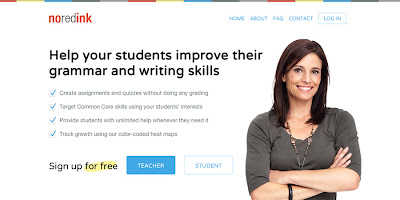
NoRedInk presents grammar drills in a short quiz format, displaying sentences that students correct by changing punctuation marks or rewriting a word to fix its tense. Dick and Jane are nowhere to be found in the sentences, which instead reference characters from pop culture, such as "Twilight" and "The Hunger Games." Teachers, meanwhile, can customize the assignments to target problem areas and view a color-coded dashboard that tracks individual students' progress.
Scheur, 33, left his eight-year teaching career in 2012 to focus full time on NoRedInk and relocated to the San Francisco Bay Area. He said he's not thinking about how to generate revenue from his company, whose product is free.
"We're super lucky that (our investors) buy into the big picture of what we're trying to do for schools and education," Scheur said. "So our sole focus is on adding value and building user engagement. We're not at all focused (on) anything to do with monetization. We're just all focused on content."
Catapult welcomes ScholasticaIt's back-to-school time, and Catapult, a shared office space for startups in the River North neighborhood, is bidding farewell to its latest graduate and welcoming its newest class member.
Catapult opened in late 2011 in a space donated by Foley & Lardner LLP, and offers six-month leases for startups that are past the idea stage and generating revenue or have raised venture capital. When openings come up, tenants interview companies that want to join.
Catapult held its third such selection process last week, looking for a startup to replace TempoDB, a cloud computing company that has been there since May 2012. Its successor at Catapult will be Scholastica, a startup that makes an online publishing platform for academic journals.
"There's this sense of momentum that I felt with the Scholastica team and their business," said Justin DeLay, TempoDB's co-founder and chief marketing officer. "And I think there is, to a certain extent, a bit of a Catapult culture, which is, everyone here is here to build a big business and a business that matters. You can sense a certain seriousness in (the) founders."
TempoDB, which was founded in December 2011, makes technology that stores and analyzes large amounts of "time series data," or time-specific information captured by thermostats and different types of sensors. The company is planning to expand its team of six full-time employees, and "it wouldn't have been fair or in the spirit of Catapult to try to overstay our welcome," DeLay said.
Three-year-old Scholastica, meanwhile, is ready for somewhat more permanent digs after having worked out of apartments, coffee shops and the office of a River North software firm. The startup's three founders are former University of Chicago graduate students in separate disciplines (sociology, political philosophy, history) who traded the academic track for an entrepreneurial one.
"The great thing about Catapult is, everyone who's there has some traction," said Scholastica co-founder Rob Walsh, who also heads product design. He added: "We can bounce ideas off of them and they can bounce ideas off of us."
Scholastica plans to move into Catapult next month. The space houses 13 companies, and TempoDB will be its 10th graduate. Foley & Lardner has invested in several companies through a fund made up of contributions from partners. The firm's primary interest, though, is courting fast-growing startups as clients.
"At the end of the day, they're always more interested in building legal business than their investments," said Galen Mason, special counsel at Foley and a Catapult co-founder. He added: "There's an appetite and a need for big-firm lawyers … to really roll up their sleeves and understand how to work with these digital technology companies and lean companies. Catapult is the tip of the iceberg."
Post Credits
Post Arthur: Wailin Wong
Email: wawong@tribune.com
 |
| Startup: Google Android Executive, Hugo Barra Joins Chinese Startup Xiaomi (OnlineWSJ) - Hugo Barra |
Startup: Google Android Executive, Hugo Barra Joins Chinese Startup Xiaomi (OnlineWSJ)
One of
Google Inc.'s
GOOG -1.00% top Android executives has left the company for a little-known Chinese phone maker, furthering a change in leadership at the company's mobile-software division.
Hugo Barra will help with a new push by Xiaomi—pronounced sheow-mee—to develop its international business and be responsible for its strategic cooperation with Google, Xiaomi said Thursday. Xiaomi, based in Beijing, has grown quickly in the world's largest smartphone market by offering inexpensive Android devices with top hardware specs.
Mr. Barra's departure comes a few months after
Andy Rubin, who was in charge of the Android operating system, stepped down to work at other projects at Google. The change in guard occurred despite Android's dominance in the smartphone industry.
Mr. Barra, a vice president in charge of Android's product management, was one of the most visible under the new Android chief, Sundar Pichai. He recently appeared at a San Francisco event where Google showed off its new Nexus 7 tablet computer and was onstage at the company's I/O developer event in May.
Mr. Barra started at Google in 2008 after the company bought voice-recognition firm
Nuance Communications Inc.
NUAN +4.26% He became the director of product management for Android in 2010 and soon rose to prominence under Mr. Rubin.
The announcement of Mr. Barra's departure comes a day after the disclosure that Google co-founder
Sergey Brin and his wife Anne Wojcicki have split. Ms. Wojcicki's sister, Susan, is a senior vice president at Google.
According to people familiar with the matter, Mr. Barra and Mr. Brin have both had a romantic relationship this year with Amanda Rosenberg, a marketing manager for the Google Glass product, the company's new line of high-tech eyewear developed under Mr. Brin. The timing and status of those relationships is unclear. Mr. Barra had considered leaving Google in the past few months, two of these people said.
Ms. Rosenberg is one of the company's most visible evangelists for the Google Glass product, who, like Mr. Brin, is often spotted sporting the device at social events in the technology industry.
Mr. Barra and Ms. Rosenberg couldn't be reached for comment. A spokeswoman for Mr. Brin and Ms. Wojcicki said on Wednesday, "We can confirm that Anne and Sergey have been living apart for several months. They remain good friends and partners." A spokesman at the Silicon Valley company confirmed Mr. Barra's departure and said: "We'll miss him at Google and we're excited that he is staying within the Android ecosystem."
The hiring was first reported by website All Things D, a unit of Wall Street Journal parent News Corp. Xiaomi's business model doesn't revolve around the hardware it sells, but rather software, service offerings and accessories. The company, which uses its website as its primary sales platform, offers an array of accessories as diverse as multicolored batteries, casings, hats and even dolls of Xiaomi's rabbit mascot.
It also now offers a set-top box that streams licensed Internet content for television sets and is integrated with the software the company runs on its phones, which are based on Google's Android operating system. The hiring of Mr. Barra shows Xiaomi has ambitions to grow beyond China. In April, the company made its first foray into markets outside of the Chinese mainland, selling its phones in Taiwan and Hong Kong.
In a statement posted on Google's social-networking platform, Mr. Barra wrote: "I'll be joining the Xiaomi team in China to help them expand their incredible product portfolio and business globally…I'm really looking forward to this new challenge, and am particularly excited about the opportunity to continue to help drive the Android ecosystem."
Post Credits
Post Arthur: Paul Mozur and Evelyn M. Rusli
Email: paul.mozur@wsj.com
 |
| Startup: Twitter Buys Online TV Start-up Trendrr (TimesofIndia) |
Startup: Twitter Buys Online TV Start-up Trendrr (TimesofIndia)
A start-up specializing in tuning into online banter by TV viewers said on Wednesday that it has been bought by Twitter.
Trendrr chief executive Mark Ghuneimannounced in a blog post that the New York-based firm is becoming part of the globally popular messaging service.
"Over the last five years we have led the way in working with real-time data and television, unlocking the power and value of engagement around TV and creating compelling media experiences around content," Ghuneim said in the post.
"We are excited to be
joining Twitter's world class team, enabling us to realize bigger opportunities that drive better experiences for users, media and marketers."
Trendrr software tracks and analyzes in real-time
social networkexchanges about
television shows or ads to provide insights into what viewers think of programming. Internet lifestyle trends include people using "second screens" such as smartphones or tablets to share thoughts on Facebook,
Twitter and other online venues.
"Having sat at this intersection of TV and social media for years, we've analyzed data from lots of platforms," Ghuneim said.
"What makes Twitter uniquely compelling among these platforms is its connection to the live moment - people sharing what's happening, when it's happening, to the world."
Trendrr in July reported that a study showed that the amount of television-related chatter on Facebook was five times greater than that on all other online social
networks combined.
Post Credits
 |
| Startup: Info Tech Giant, Apple Seeks To Trademark “Startup” In Australia (Startupsmart) |
Startup: Info Tech Giant, Apple Seeks To Trademark “Startup” In Australia (Startupsmart)
Apple has lodged a trademark application for the term “
startup” in Australia. The application covers a wide range of usage. Apple lodged a similar, unsuccessful claim in Australia in 2011.
Here is a screenshot of the application:

A spokesperson from IP Australia, the body that administers Australia’s intellectual property rules, says if the application passes the examination phase, and isn’t successfully opposed, the term could become officially protected after seven-and-a-half months.
“It won’t be officially protected for at least seven and a half months. If it is accepted, there is a chance to oppose, although it is only a two month window from the date the application is accepted,” the spokesperson told StartupSmart.
Brian Goldberg, an intellectual property lawyer at Premier IP Ventures, told StartupSmart there was a possibility Apple may successfully pass the examination phase if they have used the term enough. “With significant usage, there is a possibility it will pass the examination phase,” Goldberg says.
“From the date the trademark is registered (after the opposition period), then using the word `start-up’ as a prominent branding feature will be restricted and prevented by Apple.”
If Apple passes the examination phase, Goldberg says anyone can oppose the application within a two month period.
“Anyone that feels they don’t want this mark to become registered in Australia for these services can oppose this,” Goldberg says.
He says it’s likely that if Apple is successful, they will be proactive in enforcing their trademark.
“Based on Apple’s past behaviour with trademarks, especially for any version of the ‘i’ mark, they will strongly enforce their position.”
“In Australia there is a two-tier system, one is common law rights and the other is trademark rights. So if you’re already using ‘startup’ as your brand, and you’re not infringing someone else’s trademark, then you should have rights to at least co-exist.”
Goldberg adds people keen to oppose the trademark application will need to focus on meeting the opposition terms.
“From a technical point of view, any one person can oppose, and there are criteria on which you oppose, and that can be enough. If it came from several different fronts, that would enhance the likelihood of the opposition being successful if they meet the terms.”
Apple’s Australian lawyers were not able to be immediately reached for comment.
Post Credits
Post Arthur: Rose Powell
How To Avoid Ruining The Startup You Just Bought, From A Google - YouTube Engineer (Forbes)
 |
| Start-Ups: How To Avoid Ruining The Startup You Just Bought, From A Google - YouTube Engineer (Forbes) - Billy Biggs |
Billy Biggs is an engineer’s engineer, someone who writes video, music, and Internet telephony software for fun when he’s not on his day job as principal architect for YouTube’s computer systems and software. His day job is pretty cool, too: He’s credited with helping
Google GOOG -1.94%‘s video site YouTube attract 6 billion hours of video a month viewed by more than a billion people.
One of the
rising stars I
profiled in Forbes’ third annual
list of the world’s most innovative companies, Biggs talked at some length about his and YouTube’s approach to product development, in particular developing engineering systems. It struck me that his method of fostering innovation is increasingly relevant today, when big companies spend big money for startups. Think
Facebook FB -4.11%-Instagram, Google-Waze, and
Yahoo YHOO -2.54%-Tumblr, to name just a few recent examples.
The problem with relatively big acquisitions like this is that they still often get lost inside the acquiring company, whose managers then proceed to do everything they can to stifle them. Pretty soon, it’s all about goodwill writedowns, fleeing founders, and press pile-ons. Right, Yahoo? Google?
Microsoft MSFT -2.61%?
Facebook and Yahoo may not say it publicly, but it’s a good bet that Google’s handling of YouTube after its 2006 acquisition–allowing it to operate separately in a location 30 miles from headquarters and even letting it maintain some measure of its own culture–is a model for the more recent acquisitions. Since YouTube is now widely acknowledged as a successful acquisition for Google, Facebook and Yahoo (and so far, Google itself with Waze) have maintained, to varying degrees, autonomy for their new units. YouTube’s approach to product development may provide a guide to how these companies and others can at least try to avoid stifling its expensive acquisitions while also imparting the experience and scale that can help them flower.
Biggs had a unique perspective as the first Google engineer to move over to YouTube after the acquisition. So he could compare the tactics employed by a startup vs. the tactics employed by a large company. “I was on Google
Video just long enough to feel that I was desperately trying to compete with startups effectively,” he says. Google had a lot of parallel computer systems it was applying to video, while YouTube had systems that were “scrappier and simpler but still worked.”
One lesson he learned is that it’s not always best to focus just one team on a particular problem, even if that appears to be the most economically efficient. “I think there is something to be learned from getting multiple perspectives,” he says. “You don’t want to cut yourself off from seeing multiple perspectives. You can learn a lot from doing the same thing two different ways and then picking the best one.”
What’s more, he says, “different people sometimes see different things as being the hard problem. Sometimes you can spend a lot of time obsessing about what is the hard problem, and solve it, whereas someone with another perspective might not see that as the hard one.” So putting more than one team on a particular project can help work past these problems more quickly.
Playing the YouTube Way and the Google Way against each other to find the better way to solve a problem. “You try it the YouTube way and test the hypothesis,” he says. “That’s one of the ways you build innovative products–by encouraging diversity in a controlled manner that allows you to learn from it. You want to compare and contrast two things and pick the one that’s better.”
Another lesson was that simplicity nearly always works best, even for really large-scale systems that seem as if they need to be fiendishly complex. “Simple things work really well,” he says. “Sometimes when people talk about building something at scale it means something complicated. Usually it means building something simple where there’s fewer moving pieces because then it’s cheaper to run at really high volume. Finding a simple solution to something is actually rather challenging.” Indeed, he says, Google learned a lot from YouTube, which he says had built “conceptually fairly simple systems.”
Not least, he says, it pays to try to maintain the scrappy culture of many startups. “We have kept enough of the startup culture to ensure that on the engineering side, we’re able to encourage doing things rough and quick more than slow and steady,” he says. “Some of that naturally changes as you get bigger. But it’s certainly still a good part of the engineering culture.”
Post Credits
Post Arthur: Robert Hof
 |
| Start-Ups: Meet The 15 Companies To Present On Stage During TNW USA Mobile Startup Rally! (TheNextWeb) |
Start-Ups: Meet The 15 Companies To Present On Stage During TNW USA Mobile Startup Rally! (TheNextWeb)
With little over a month left until our first edition of
TNW Conference USA in New York, it is now time to reveal the first 15 finalists of our
Mobile Startup Rally.
The biggest technology and media trends are influenced by mobile. That’s why this year’s competition is focussing on the most mobile minded startups. Over a hundred applicants from all over the world participated in a series of video pitches and interviews in order to make it to the final 15 who will present on stage at TNW USA.
That’s not all though; 5 additional finalist positions will be awarded at the TNW Conference among the startups with a
Startup Table or Demo Desk in the exhibitor space.
The competition is proudly sponsored by
Adyen. Starting in 2006 by a small team of payment experts, Adyen has now spawned a company that employs more than 150 people in seven countries on four continents. Being a
very successful startup themselves, they are delighted to share their lessons and discuss today’s modern payment strategies that will successfully propel participating startups towards their monetization goals.
Mobile Startup Rally aside, TNW USA will be host to a great set of speakers on tech, media, entertainment and fashion. The event takes place on 1 and 2 October 2013 in New York (Chelsea). You can still
grab a steep discount (35% off) by registering two tickets or more before September 6th.
Looking forward to see you in New York! Without further ado, here are the first 15 finalists:
The 15 Finalists Are:
24me
From: Ganey Tikva, Israel
Quick pitch: “The Next Generation Personal Assistant”
Admitted.ly
From: New York, United States
Quick pitch: “Ultimate online college advisory tool for high school students, their parents, and guidance counselors”
Candobaby
From: New York, United States
Quick pitch: ”The first App to offer an easy system to document all a child’s milestones, and turn them into exquisite, professionally printed photo baby books, straight from an iPhone!”
Heystack
From: Hertzelia, Israel
Quick pitch: “The right way to meet the right people”
Instabug
From: Giza, Egypt
Quick pitch: “Instant bug reporting tool for mobile apps”
Jackpocket
From: New York, USA
Quick pitch: “A fortune in your pants.”
Jampp
From: Buenos Aires, Argentina
Quick pitch: ”Jampp solves the App Promotion puzzle.”
Neomatix
From: Tel Aviv, Israel
Quick pitch: “Electro-Optic solutions for drivers and vehicle fleets”
nextSociety
From: New York, United States
Quick pitch: “Your ultimate networking tool.”
Pandadoc
From: San Francisco, United States
Quick pitch: “Send, Receive, Annotate, and Sign Digital Documents”
RareWire
From: Kansas City, MO, United States
Quick pitch: ”The only 100% cloud-based native mobile app development platform.”
Tales & Tours
From: Amsterdam, The Netherlands
Quick pitch: “Your personal tourguide in your pocket”
Taxi Startup
From: Talinn, Estonia
Quick pitch: “The evolution of the taxi industry”
Ukky
From: Utrecht, The Netherlands
Quick pitch: ”Create a beautiful baby photo book from your iPhone in a snap.”
Zoobe
From: Berlin, Germany
Quick pitch: “Zoobe creates free to use applications for smartphones, that turn personal voice recordings into animated video messages.”
Post Credits
Post Arthur: Sophie Op den Kamp
Sophie is TNW's Events & Marketing Manager. Finds good karma in geek-to-person advocacy. Her motto: "Don't take yourself too seriously, it gives you freaky frown lines."
 |
| Start-Ups: Smart Planning To Fund Your Startup (Forbes) - Tree Growing On Coins |
Start-Ups: Smart Planning To Fund Your Startup (Forbes)
Starting a new business can be overwhelming. Whether a company is trying to get off the ground or grow to the next level, a financial plan can help entrepreneurs focus their efforts and prepare for success, according to
SCORE, a nonprofit dedicated to helping start-ups.
A solid financial plan can help owners avoid the causes of cash flow problems, anticipate financing needs, and keep borrowing under control, according to SCORE’s downloadable workbook, “
How to Really Start Your Own Business.” What should businesses consider when making a financial plan?
Make it Personal
One of the first considerations for startups is determining which sources of funding are available. Personal financing options include self-financing through savings or credit and obtaining financing from friends and family. A financial advisor can help you sort through your options.
When approaching friends and family, “Go very slowly,” says business plan expert Tim Berry, founder of
Bplans.com. When approaching friends and family, make sure those who are willing to invest in your business understand up-front how easily the money can be lost, he says.
For friends and family, a concise financial plan (3-6 pages) may work best, reports SCORE. It should cover the basics, including an executive summary, a description of your business, market, competition, and product, as well as your plans for marketing and management, financial data, and return for investors.
Just as instability in your personal finances would be discouraging and stressful, the same will naturally be true for your small business. In fact
a recent study of young aspiring entrepreneurs in the UK showed they considered a lack of funding the number one barrier to starting a business. Establishing a plan early and with funding from sources you trust can give you the peace of mind and confidence you need to focus on your business goals.
Look Outside
To approach outside investors such as bankers and venture capitalists, a more formal written business plan is appropriate, says SCORE. Outside sources of funding include commercial bank loans, which are available for working capital and even expansion, but require collateral. The
U.S. Small Business Administration (SBA) also guarantees loans for small businesses in some circumstances.
Venture capital is another possibility for companies that are aiming for multimillion-dollar sales, says SCORE. Venture capital firms typically look for repeat entrepreneurs and plans with huge growth rates in high-growth industries, adds Bplans’ Berry.
Angel investors include individual investors and investment groups. They also tend to require solid business plans, but may be more likely than venture capitalists to invest smaller amounts or accept less ownership.
Startups often require a combination of both short-term investment capital and long-term debt, reports SCORE. A basic rule of thumb is to use short-term financing for short-term needs and long term financing for long-term needs, the organization says.
Financing Options
There are two types of financing: Debt, which is borrowed and must be repaid over time, and equity, which is money raised by a company in exchange for a share of ownership in the business,
according to the SBA. There are pros and cons to each: Debt financing usually involves paying interest, but also enables owners to retain full ownership. Equity financing, on the other hand, reduces ownership but can improve a company’s credit worthiness.
Banks and businesses usually deal with debt, while investors typically deal with equity, according to the SBA. When looking for funding, one thing to consider is your company’s debt-to-equity ratio between money you have borrowed and money you have invested, the SBA reports. The more money you have invested, the easier it is to get financing.
SCORE’s workbook offers more information in all of these areas, as do financial advisors and networks such as the SBA, local chapters of SCORE, and local chambers of commerce. There’s a lot to figure out when starting a small business, but making a financial plan and working with a financial advisor is always a good first step.
Post Credits
Post Site: Northwestern Mutual via www.forbes.com
Post Arthur: Lisa Wirthman
Lisa Wirthman writes about business, sustainability, public policy, and women’s issues. Her work has been published in The Atlantic.com, USA Today, U.S. News & World Report, Fast Company, Investor’s Business Daily, the Denver Post and the Denver Business Journal.
Follow on Twitter: www.twitter.com/LisaWirthman


![Startup: The Ultimate Startup Small Business Checklist [Infographic]](http://cdn.bitrebels.netdna-cdn.com/wp-content/uploads/2013/10/The-Small-Business-Checklist-Infographic.jpg "Startup: The Small Business Checklist Infographic - www.techgrity.blogspot.com")


